Aug 31, 2026Journal entry
How Studying Percussion in Cuba Changed the Way I Hear Music
How years of studying and listening to Cuban percussion changed the way I hear clave, syncopation, triplets, rhythmic layering and the drum set.
I have been fascinated with Cuban rhythms for a long time. Even before I ever went to Cuba, the syncopation in Afro-Cuban and other Latin music did something to my brain that a lot of the rock and pop music I grew up listening to did not. I grew up on a lot of classic rock, 80s and 90s American pop, metal and other music where the quarter-note pulse is usually pretty obvious. Then when I got into music school in Atlanta and started learning some Cuban and Latin rhythms, suddenly my brain had to work in a completely different way.
As a drum set player, most of what I originally learned was translated for the drum set. We would learn something like a Mozambique or a songo pattern and figure out how to orchestrate all of those parts between the hands and feet. Songo in particular has become a pretty standard thing for drum set players to study. That is valuable, and I still love learning that way, but I eventually started to realize that I was learning an adaptation of the music before I really understood where all of the individual parts came from.
I should also make something clear here. I am a drum set player and that is where I have chosen to focus most of my serious practice throughout my career. I am really not that great of a percussionist. I have studied conga and bongo technique, I can play cajón and some other percussion instruments, and I can cover those kinds of parts if somebody needs me to on a gig or recording. But at some point you have to decide where you are going to put thousands of hours of practice, and for me that has always been the drum set.
Studying percussion in Cuba was never really about trying to turn myself into a Cuban percussionist. It became much more about understanding the music better, and eventually it changed the way I hear rhythm in general.
Learning percussion through the drum set
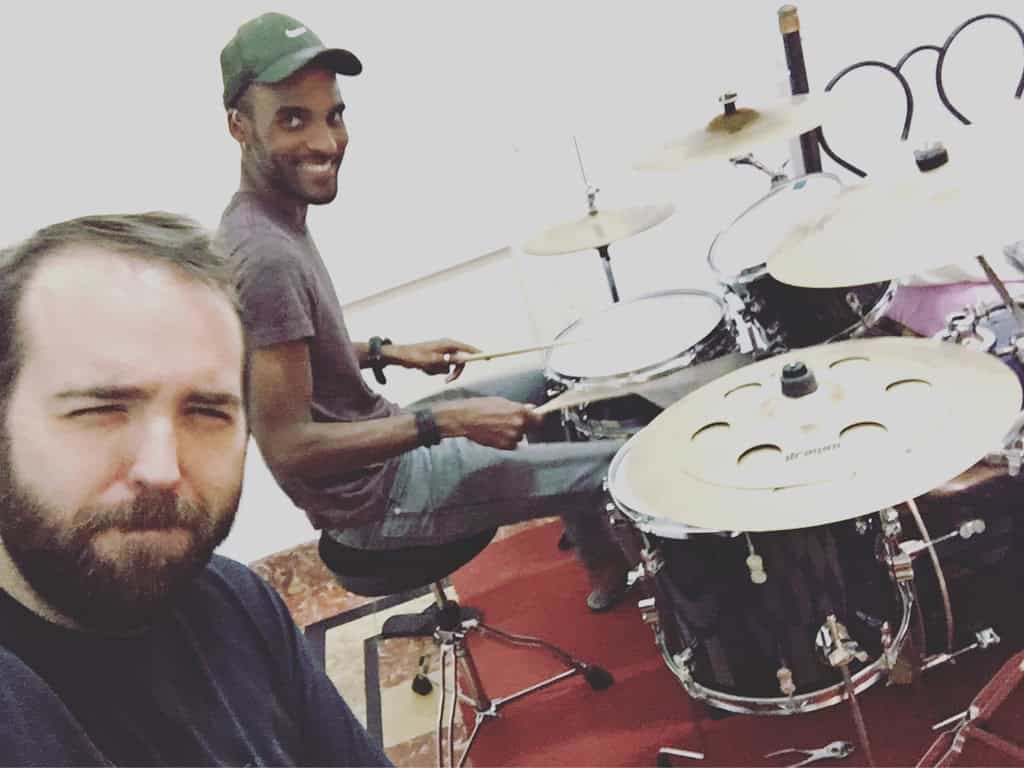
One of the first people I studied seriously with in Cuba was Karel Ramos, my original drum teacher there. A lot of what I learned from him was exactly what I had been looking for. He was not just showing me an isolated percussion pattern. He was helping me understand how a Cuban drummer could hear the percussion around him and interpret some of that language on the drum set.
That was important for me because the drum set is already a kind of percussion ensemble being played by one person. Your feet and hands can represent different parts, but the point is not simply to cram every percussion instrument onto four limbs. The more useful question is which part of the rhythmic conversation matters at that moment, and how can the drum set support it without losing the feel of the music?
Hearing the individual parts instead of just the drum set groove
One of the biggest differences for me was getting deeper into the idea that a lot of African-derived percussion music is built from multiple people playing different rhythmic parts at the same time. Each part has a role, and sometimes if you isolate one of those parts it may not even sound like much by itself. Then you put the parts together and this whole rhythmic conversation starts happening.
Rumba is probably the most obvious Cuban example for me. You have the clave, the guagua or catá, the different conga parts, the quinto improvising and interacting with the dancer, plus the singing and everything happening around it. It is not really a "drum groove" in the way that a drum set player normally thinks about a groove. It is multiple people creating the groove together.
When you learn Cuban music on drum set, you are often trying to take some of those individual ideas and combine them onto one instrument. Your left foot might represent one part, your right hand another, the snare something else, and so on. That is one of the things I love about the drum set. You can create this miniature percussion ensemble with one person.
But there is also a danger in learning everything that way. You can learn the coordination and still miss the relationship between the parts. That was something that started changing when I spent more time in Cuba, studied with different percussionists and, probably more importantly, just spent an enormous amount of time listening to the music.
We also spent a lot of time with members of Los Muñequitos de Matanzas, and one of the clips I want to include with this journal shows a few of the musicians improvising over rumba rhythms. It is a good example of what I mean because you can actually hear the layering. The individual parts are relatively understandable when you focus on them one at a time, but when everybody starts interacting, the syncopation becomes much bigger than any single pattern.
The clave started becoming more than a pattern
In most of the music I grew up playing, if somebody turned on a metronome, the quarter note was basically the reference point. One, two, three, four. Even when you are playing complicated things around it, you can usually hear that pulse pretty clearly.
Cuban music made me think about that differently because so much of the rhythmic phrasing is organized around the clave.
When people first learn clave outside Cuba, we tend to learn it almost like another rudiment. You memorize the five notes, learn 3-2 and 2-3, and then start putting different grooves around it. Again, that is useful. But after listening to enough Cuban music, I started thinking about clave less as five notes that somebody is playing and more as something that is organizing where the music wants to go.
For example, what is commonly taught as a 3-2 guaguancó or rumba clave can be counted over two bars as:
1, the & of 2, the & of 4 | 2, 3
A common 3-2 son clave is almost exactly the same:
1, the & of 2, 4 | 2, 3
It is only a small rhythmic difference on paper, but once you really start listening to the music, that difference matters.
And even calling something "the rumba clave" can get overly simplified pretty quickly. There are different rumba traditions and regional approaches throughout Cuba. Havana and Matanzas have their own histories and ways of playing guaguancó, and once you start talking to musicians from different parts of the country, you realize there is almost always another version of something.
Matanzas is especially interesting to me because there always seems to be a slightly different rhythmic variation there. You will hear musicians talk about guaguancó matancero and the particular rhythmic language associated with Matanzas. Then you go east and there are other traditions and ways of feeling things again. The more I learned, the less interested I became in saying, "This is the Cuban way to play this rhythm," because there usually is not only one Cuban way.
A game my wife and I used to play
My wife, Yami, is a Cuban musicologist, and we used to have this little game when we were out listening to music. I would start tapping what I thought was the clave on her leg. I was probably right about 80 percent of the time. Every once in a while I would have it wrong and she would tap the correct clave back on my leg.
At first this could drive me a little crazy because there were songs where I thought, "How is the clave there?" It did not always line up with where my brain wanted the beginning of the phrase to be.
Then I started listening for the other clues inside the music. Sometimes the vocal phrase tells you where you are. Sometimes it is something inside the arrangement. In son-based music, the bass line can tell you a lot. Other times you have musicians who know the rhythmic language so well that they are intentionally playing around with your expectations.
That gets even more interesting in Cuban jazz and some of the more rhythmically complicated modern Cuban music. Everybody knows where the clave is, which means they also know how far they can move around it without actually losing it.
That little game with Yami ended up being really good ear training for me because I was no longer just asking, "What rhythm is the drummer playing?" I was trying to understand why the entire song was phrased the way it was.
Syncopation started to feel different
I think this is probably the biggest long-term effect Cuban music has had on my playing.
When you grow up hearing a strong quarter-note pulse all the time, syncopation can initially feel like something you put around that pulse. Here are the four beats, and now we are going to put some interesting notes between them.
After spending years listening to Cuban music, that relationship started changing in my head. The syncopated note does not necessarily feel like the unusual note anymore. Sometimes that is actually the note the entire phrase is pulling toward. That changes how you feel the bar line too.
I have become much more comfortable with rhythmic phrases that move across the bar line instead of neatly wrapping themselves up before beat one. I notice this especially with triplets. Cuban drummers and percussionists have had a big influence on the way I hear triplet phrases, especially quarter-note triplets and phrases that seem to stretch across the bar and resolve somewhere you might not initially expect.
It is hard to explain this without sitting at a drum set and demonstrating it, but there is a certain way great players can let a triplet phrase almost float over the time. The pulse never actually disappears, but for a second the phrasing makes you hear the time from another angle. Then everybody lands together again.
When it is done really well, it does not sound like somebody is trying to play something complicated. It just sounds musical.
I have noticed more and more of that coming into my own playing. Sometimes I am playing rock music, heavy music or something atmospheric that has nothing specifically Cuban about it, but I will hear myself phrase a fill across the bar line or put a triplet somewhere that I probably would not have done years ago.
That is where I think musical influences become really interesting. I do not necessarily want to put a Cuban rhythm into every piece of music I play. I would rather have years of listening to Cuban music change the instincts I bring into whatever I am playing.
Listening has probably taught me the most
I have taken lessons with some really great musicians in Cuba and learned a lot from studying the actual techniques and rhythms. I believe strongly in studying with people who really know the tradition. But if I had to choose the thing that has probably changed me the most, it would be listening.
And I mean a lot of listening. That is something that I do not think you can speed up.
You can travel to Cuba, study with a great percussionist for a week, learn some really cool rhythms and come home with a notebook full of material. That is all great. But you are not going to internalize in a week what somebody else has been hearing since they were a child.
I grew up with American rock and pop music completely embedded in my brain. Nobody ever had to teach me how a basic rock backbeat was supposed to feel. I had heard it thousands and thousands of times before I even knew what I was listening to. Cuban musicians have the same type of relationship with their own musical language.
So for me, studying this music has been a long process. Sometimes I would learn something in Cuba and understand it intellectually, but I did not really hear it yet. Then I would listen to hundreds more songs, go back to Cuba, hear more live music, study with somebody else, listen to Yami explain something, and eventually some part of it would start feeling natural.
There are things I studied years ago that I think are only now really showing up in my playing. I actually like that. Music is a lifelong pursuit and I do not think everything needs an immediate result.
Learning to hear the whole thing
One thing I have noticed as I have gotten older is that I listen less and less exclusively to the drummer. Of course I still listen to the drums. I am a drummer. If somebody plays an incredible fill, my ears are probably going straight to it. But I find myself paying much more attention now to how the drums relate to the bass, where the vocal phrase sits, what another percussion instrument is implying and how all of those things work together rhythmically.
Cuban music played a huge role in developing that part of my ears.
That brings me back to rumba because I think rumba demonstrates this better than almost anything. If you only listen to the quinto, you are missing the other percussion. If you only listen to the percussion, you are missing the singing. If you ignore the dancer, you are missing part of what the quinto player is responding to. Everything is connected.
The first Cuban rhythms I learned attracted me because they were complicated. They fired up my brain. I liked trying to figure out where all those syncopated notes landed and how I could coordinate them on drum set.
Years later, I think I am interested in almost the opposite thing. I am less interested in proving that I can understand a complicated rhythm and more interested in hearing how naturally all of those rhythms coexist.
That is probably the biggest thing studying percussion and spending time around musicians in Cuba has given me. I did learn rhythms, techniques and coordination, but more importantly, it slowly changed the way I listen. I feel syncopation differently than I did before. I hear phrases stretching across bar lines differently. Triplets feel different. I hear the relationship between instruments differently. And I think I am much more comfortable letting the rhythm imply where the pulse is instead of constantly having to state it.
None of that happened during one lesson or one trip. It happened from listening, studying, going back, getting things wrong, listening some more and gradually letting another musical language become part of the way I hear music.
I think that process is still happening.
Experiencing Cuban music in context
A lot of what I am writing about here came from being around the music in Cuba, not only from formal lessons. Through my company Havana Music Tours, we have spent years building educational music and cultural trips that connect travelers with Cuban musicians, ensembles and the communities where these traditions actually live. If you are interested in experiencing Cuban music this way, you can learn more about our Cuba educational music, dance and culture trips.